Why I Attended—and Why This Event Happened Now
It's a crisp February morning in Delhi, and I'm weaving through the bustling streets toward Bharat Mandapam, my backpack stuffed with a notebook, laptop, and enough chai-fueled optimism to last the day. As a full-stack developer running codevichar.com from Uttar Pradesh, I've been knee-deep in JavaScript frameworks and Angular projects, but AI? It's been creeping into my workflow—generating code snippets, debugging edge cases, even brainstorming blog ideas.
When I heard about the India AI Summit 2026, I knew I had to be there. Not just for the hype, but because India's AI scene is exploding, and I wanted to see how it ties into real-world dev work.
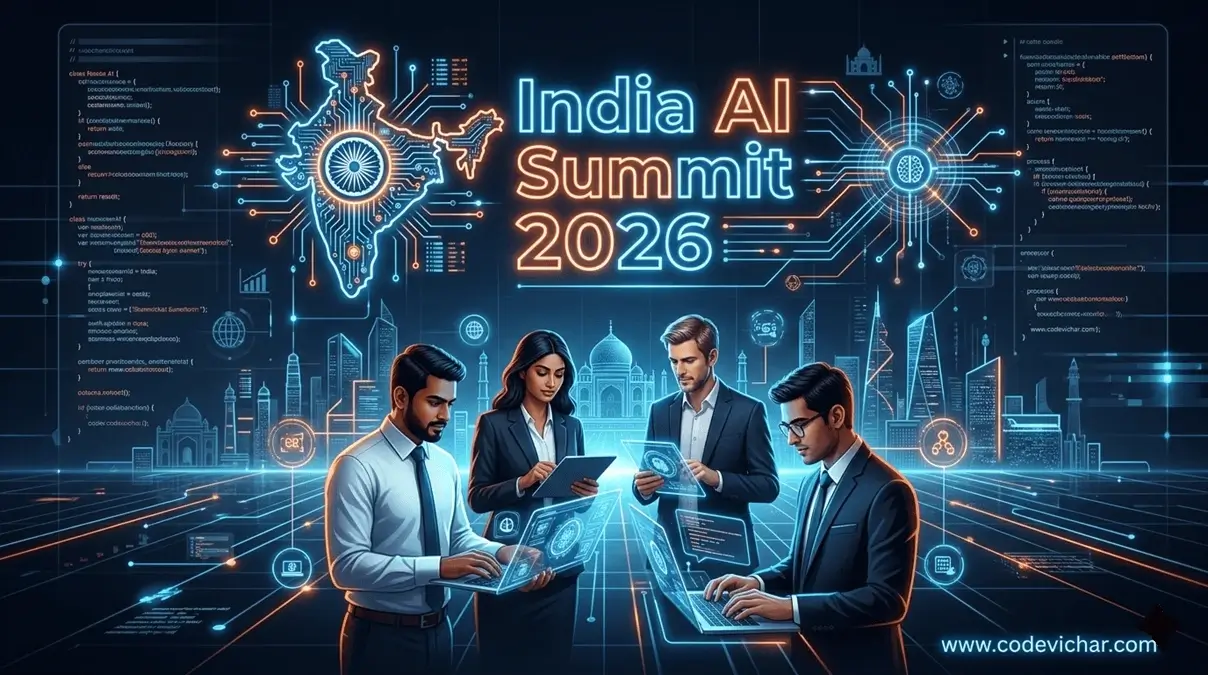
This summit didn't pop up out of nowhere. India kicked off its AI Mission back in 2024 with a massive ₹10,000 crore push, aiming to democratize AI from startups in Bengaluru to rural tech hubs. By 2026, with global AI investments hitting trillions and India churning out 20% of the world's developers, the government timed this perfectly.
PM Narendra Modi himself flagged it off virtually, tying it to "Viksit Bharat" by 2047—making India an AI powerhouse. Bharat Mandapam, that grand convention center in Pragati Maidan with its futuristic dome and eco-friendly vibes, was the ideal spot. It hosted G20 in 2023, so scaling up for 5,000+ attendees felt natural. Organizers from MeitY (Ministry of Electronics and IT) and NASSCOM curated it to bridge policymakers, tech giants, and us indie devs.
Day 1: Keynotes That Hit Home and the Buzz in the Halls
I arrived early, grabbed my badge (shoutout to the smooth QR-scan entry—no lines!), and dove into the main hall. The energy was electric—giant LED screens flashing AI demos, delegates in sharp suits mingling with hoodie-wearing coders like me. First up: Nandan Nilekani, Infosys co-founder and Aadhaar architect. He didn't drone on about stats; instead, he shared a story from his recent trip to a Kerala village where AI-powered crop prediction apps boosted yields by 30%. "AI isn't sci-fi," he said, "it's the farmer's new plow." I nodded furiously, thinking of my own experiments with AI tools on codevichar.com—using them to optimize React hooks without copy-pasting boilerplate.
Then came the international flair. A delegation from the UAE's AI Ministry, led by their CTO Omar Al Olama, took the stage. They've poured billions into AI cities like Masdar, and Omar demoed a real-time Arabic-English translation model trained on Gulf datasets. No jargon overload—he joked about how it mangled his favorite Emirati dish name during testing, turning "machboos" into "magic boos." We laughed, but it sparked chats in the aisles: Could this scale to Hindi-English for my blog's global readers? Singapore's IMDA rep, Dr. Sia Kin Ning, followed, showcasing their "Smart Nation" AI for traffic flow. She invited a live Q&A where I asked about integrating it with Indian road chaos—her tip? Hybrid models blending satellite data with local IoT sensors. These foreigners weren't just keynote trophies; they huddled in side rooms with Indian startups, sealing MoUs on the spot.
Lunch was a highlight—massive thalis with AI-themed QR menus that suggested dishes based on your "energy scan" via a fun app. I chatted with a Mumbai indie dev who'd built an AI form validator for Angular apps. "It's like having a senior dev in your pocket," he said. We swapped war stories: My nightmare of a Redux state bug that AI debugged in seconds, versus his deep-copy fiasco in a React project.
Day 2: Workshops, Demos, and My Hands-On Moments
Day 2 shifted to action. I jumped into a workshop on "Ethical AI for Developers" run by Google's DeepMind team—yes, they flew in reps from London. We coded a bias-detection tool in Python, feeding it mock hiring datasets. My group caught a gender skew in resume screening; tweaking the loss function fixed it instantly. It felt personal—I've battled biased autocomplete in my JS tutorials, where "developer" suggestions skewed male. No theory dump; we broke into pairs, and I paired with a Delhi Uni student who taught me a neat TensorFlow trick for edge devices.
Parallel tracks covered healthcare AI (a Boston Dynamics-inspired robot demo'd remote surgeries) and agritech. I snuck into a fireside chat with Reliance's Mukesh Ambani's team, who unveiled Jio's AI cloud for SMEs. "Forget Big Tech lock-in," their lead said. "Build on our stack, deploy tomorrow." As someone customizing Blogger templates with JS, I grilled them on API latency—turns out, their edge computing shaves 200ms off calls, perfect for my site's lazy-loading images.
The expo floor was chaos in the best way. Booths from TCS hawked enterprise AI, while startups like Krutrim (Ola's AI arm) let us test voice models in Hinglish. I recorded a demo: "Bhai, ye React hook kaise optimize karega?" It spat back code with useMemo tweaks—spot-on for my next codevichar post. Foreign delegations shone here too: A French group from Inria demo'd AI for sustainable fashion, predicting dye waste, and a US team from OpenAI shared fine-tuning tips for custom LLMs. Networking? I collected 20 LinkedIn connects, including a UAE investor eyeing Indian dev tools.
Evenings wrapped with cultural twists—AI-generated Bharatanatyam performances synced to live tabla, morphing patterns based on crowd claps. I snuck a pic (event WiFi was blazing fast, 5G everywhere).
Challenges I Witnessed and Real Talk from the Trenches
Not all shiny. Panels addressed India's data woes—90% unstructured, privacy laws lagging GDPR. A NASSCOM rep admitted, "We're talent-rich but infra-poor." Power outages hit one demo (backup generators saved the day), and rural digital divides loomed large. But optimism ruled: Initiatives like IndiaAI's 10,000 GPU compute fund promise fixes.
Personally, the summit reignited my workflow. Back home, I integrated an AI copilot into my Angular router guards—testing auth flows 5x faster. It's not replacing me; it's amplifying my codevichar magic.
Scope and Follow-Ups: What's Next for India's AI Boom?
This wasn't a one-off. Scope is massive: Expect IndiaAI 2.0 with ₹50,000 crore by 2028, focusing vernacular models and sovereign data stacks. Follow-ups include regional summits in Bengaluru (June 2026) and Hyderabad (Oct), plus hackathons via NASSCOM. I signed up for their dev accelerator—watch codevichar.com for my project logs.
Attending the India AI Summit 2026 was a game-changer. From Nilekani's wisdom to hands-on hacks, it showed India's not just playing catch-up—we're leading the charge. If you're a dev like me, mark your calendar for next year. Bharat Mandapam awaits.